



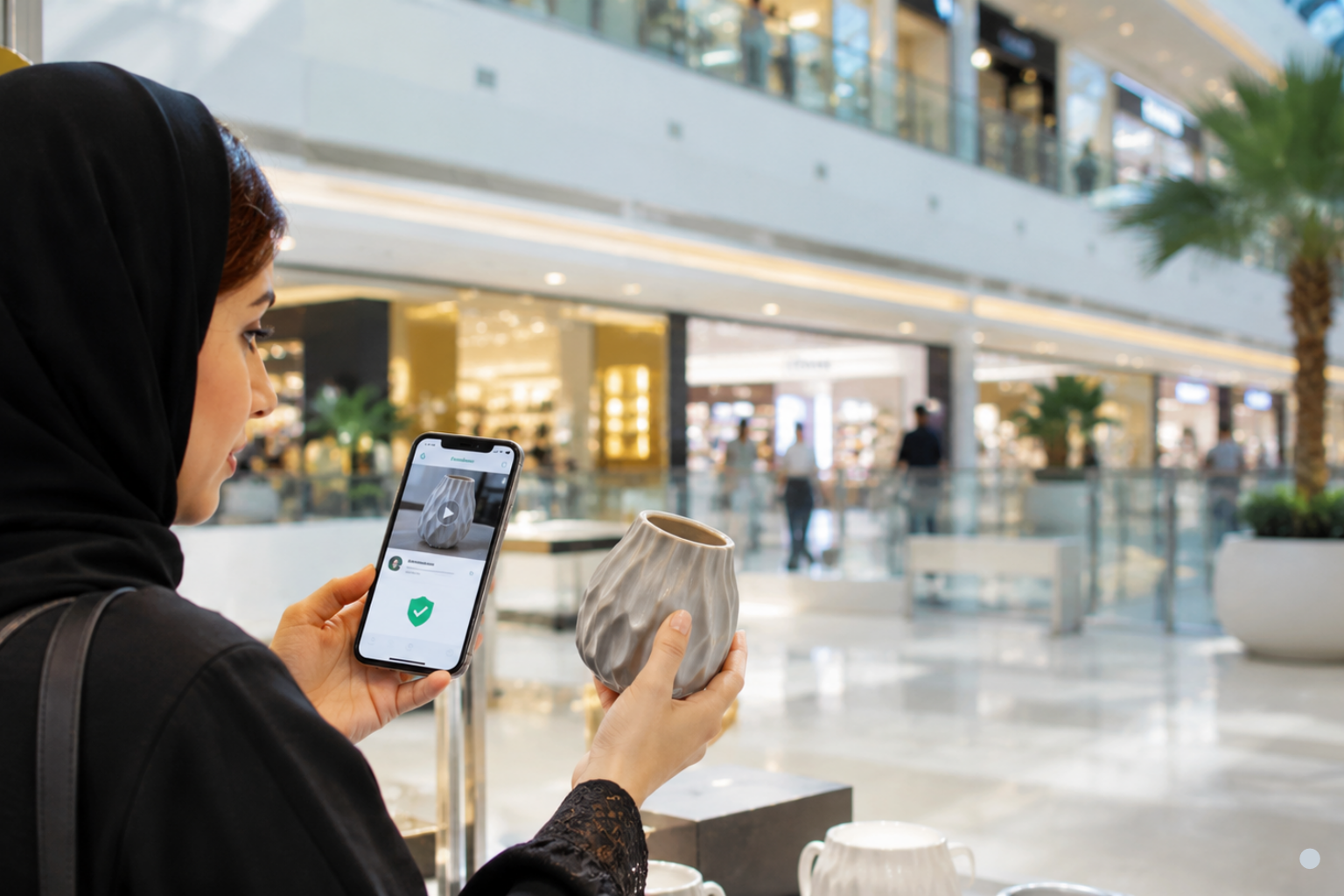
AI shopping in UAE is changing how consumers decide what to buy, often before they ever reach a retailer’s website or physical store.
Artificial intelligence is increasingly being used to compare prices, check product reviews and find ideas, while social media has become a place where consumers can discover and purchase products without leaving the platform.
Recent research suggests these tools are becoming a normal part of the UAE shopping journey. At the same time, consumers remain cautious about how far they are willing to let technology make decisions or spend money on their behalf.
Table of Contents
A 2026 Visa study found that 85% of consumers surveyed in the UAE had used AI tools to assist with shopping.
Among respondents, 60% had used AI to check reviews or product ratings, 59% to compare prices and 55% to find gift ideas.
Visa also found that 93% believed new technologies, including AI-powered tools, were making online shopping faster and easier.
Visa’s 2026 UAE study on AI shopping and social commerce
These figures suggest that AI is already playing a role before checkout. For many consumers, its current value appears to be helping with research rather than replacing the shopper entirely.
How AI shopping in UAE is changing product discovery

For years, product discovery online usually started with a search engine, retailer website or marketplace.
That journey is becoming less predictable.
A consumer looking for a laptop, skincare product or restaurant recommendation can now ask an AI assistant to compare several options, summarise reviews and explain the differences in plain language.
Tabby’s 2026 Middle East Shopping Survey found that 47.8% of UAE respondents had used AI as part of their shopping decisions during the previous 12 months.
The figure is lower than Visa’s 85% because the studies use different samples, questions and definitions. The two percentages should therefore not be directly compared.
What they share is the direction of travel: AI shopping in UAE is already part of a substantial number of consumer journeys.
Tabby’s 2026 shopping research covering UAE consumers
Tabby’s wider UAE and Saudi Arabia research also found that digital channels now play an important role in product discovery, with many shoppers deciding what they want before they enter a physical shop.
This changes the role of advertising. A brand may no longer be competing only for a position on a store shelf or the first page of traditional search results. It may also need to be understood and recommended by AI tools.
This sits within a wider technology shift across the market. UAE Business Voice has also examined UAE technology trends in 2026, including the growing use of AI, digital payments and e-commerce in business planning.
Social media is becoming a shop as well as a discovery platform
Social media is undergoing a similar change.
Platforms that were once mainly used to view photos, videos and advertisements increasingly allow users to discover products and move directly toward a purchase.
Visa’s UAE research found that 69% of consumers surveyed had purchased products directly through social media platforms.
Visa study on social commerce among UAE consumers
This reduces the distance between seeing and buying. It also shows how AI shopping in UAE increasingly overlaps with social discovery and product comparison.
A consumer can watch a product demonstration, read comments, visit a seller and make a purchase within a relatively short digital journey.
DHL’s social-commerce research also shows strong use of major social platforms among UAE online shoppers, with Facebook, Instagram and TikTok all playing a role in how consumers interact online.
DHL research on social commerce and online shoppers
For retailers, this means social media is no longer only a marketing channel. For some consumers, it is becoming part of the shopping infrastructure itself.
Price remains a major reason people use AI
Although AI technology can sound complex, one of the clearest uses of AI shopping in UAE is also one of the oldest consumer concerns: finding a better price.
Checkout.com’s 2026 research found that 71% of UAE consumers surveyed were open to an AI shopping agent choosing an alternative brand if it offered better value.
It also found that some UAE consumers were interested in using AI to discover products they might not otherwise find.
Checkout.com research on UAE attitudes toward AI shopping agents
This could create new pressure on brand loyalty.
If an AI system is asked to find the best option within a certain budget, it may recommend a product from a brand the consumer has never used before.
That changes the decision from “Which product does my preferred brand sell?” to “Which product best meets my requirements?”
For businesses, the difference is important.
Consumers are interested in AI but do not give it unlimited trust
High use of AI does not mean consumers are ready to hand over complete control.
Visa’s June study found that while 85% had used AI to assist with shopping, only 32% said they would trust AI agents to complete checkout.
That is a large gap between accepting help and allowing technology to spend money, and it shows why trust remains central to AI shopping in UAE.
Visa findings on trust and AI-assisted checkout in the UAE
Checkout.com has also found that UAE consumers want safeguards around AI-led purchases.
Its research found that shoppers cared about issues such as spending control, clear records of what had been approved, easy dispute processes and protection against unexpected costs.
Checkout.com analysis of trust and control in AI commerce
This is an important distinction.
Consumers may be comfortable asking AI to compare televisions, find cheaper flights or summarise reviews without being comfortable giving the same system unrestricted access to their payment details.
AI-assisted shopping and fully automated shopping are not the same thing.
Social commerce creates its own trust problem
Social shopping also comes with risks.
Visa’s research found that 46% of UAE respondents said they had experienced a financial scam during the previous 12 months. Among those who had experienced a scam, 38% said it happened on social media.
Visa’s UAE Stay Secure research on online scams and social commerce
That means the same platforms making products easier to discover can also create questions about seller identity, payment security and authenticity.
For consumers, convenience has to be balanced with verification.
For legitimate retailers and platforms, trust may become more important as social shopping grows because consumers need to know who is behind an offer before paying.
Businesses are preparing for another stage of AI shopping
The next stage of AI shopping in UAE could involve AI doing more than research.
Visa launched an Agentic Ready programme in the UAE in May 2026 as financial institutions and payment companies began testing systems in which AI agents can help consumers discover, choose and eventually complete transactions.
Visa said research conducted with Fast Company Middle East found that nearly 60% of UAE businesses surveyed expressed strong interest in, or were actively exploring, agentic commerce use cases.
Visa’s UAE Agentic Ready announcement and business research
Checkout.com has reported similarly strong consumer interest. In one 2026 UAE study, 79% of consumers surveyed said they felt comfortable with the idea of AI completing purchases on their behalf, although the company also stressed the need for controls, refunds and clear responsibility when something goes wrong.
Checkout.com 2026 research on consumer demand for AI shopping
Different studies produce different percentages because they ask consumers different questions. What matters more than any single number is that AI is moving steadily from product research toward deeper involvement in buying decisions.
Shopping decisions are becoming less linear
The traditional path from advertisement to store to checkout is becoming harder to describe.
A UAE consumer may see a product in a social video, ask an AI assistant whether it is good value, compare prices on several websites, read customer reviews and then buy through an app.
Another person may do the research online but visit a physical store before making the final decision.
The result is not the end of traditional retail or advertising. It is a more complicated decision process in which search engines, social platforms, AI tools, marketplaces, apps and physical stores can all influence the same purchase.
For businesses, the challenge is increasingly about being easy to find, easy to understand and easy to trust wherever that decision begins.
For consumers, AI shopping in UAE and social commerce offer more information and faster comparison. But the latest UAE research also makes clear that convenience alone is not enough.
Trust, price, transparency and control still matter when the final decision is made.
Research sources
This report was prepared using publicly available 2026 research from Visa, Checkout.com, Tabby and DHL.
The studies used different survey samples and definitions of AI-assisted shopping, social commerce and agentic commerce. Their percentages should not be combined or treated as measurements of exactly the same behaviour. They are used here to show different parts of how shopping decisions are changing in the UAE.